Showing posts with label Space. Show all posts

Wednesday, April 17, 2013


Captured the moment of the birth of a black hole


 There is evidence that the explosion of this star, W49B, left behind a black hole <i>(Image: X-ray: NASA/CXC/MIT/L.Lopez et al.; Infrared: Palomar; Radio: NSF/NRAO/VLA)</i>

Lost neutrinos may help set off weak flashes of light that signal a black hole's birth.

It's thought that very massive stars explode when they die, and the stuff left behind collapses into either a neutron star or a black hole. But models of dying giant stars don't reliably produce supernova explosions, says Elizabeth Lovegrove of the University of California, Santa Cruz. "Some stars are harder to blow up than others," she says.

Previous work suggested that most of the stars that form black holes implode instead, making them hard to spot. "Is it possible for a star to just disappear inside a black hole without a trace?" wondered Stan Woosley, also at UCSC.
Neutrino exodus

Lovegrove and Woosley realised the key to seeing an imploding star may lie in the large number of neutrinos released from a dying star's core. Without the neutrinos, the core suddenly becomes lighter. According to their model, this change sends a shock wave through the star's outer layers, which then fly off, glowing brightly as they do.

In a separate study, Anthony Piro of the California Institute of Technology in Pasadena calculated what would happen to the released gas in the first few days after the star's collapse. He found that the flash of light from a dying supergiant star would be weaker than a supernova, but bright enough for us to see and identify with current and future telescopes.

Christopher Kochanek, an astronomer at Ohio State University who was not involved with the current research, is excited at the prospect: "What would beat seeing a black hole form? How much cooler can you get?"

Tuesday, April 16, 2013


Further hints of dark matter detected


Hints of dark matter, the mysterious stuff that makes up perhaps 85 percent of the matter in the universe, may have been observed by scientists.

But researchers are far from saying they've discovered the source of dark matter.

"We're not claiming anything," warned Blas Cabrera, a Stanford University physicist speaking here yesterday(April 15) at a meeting of the American Physical Society.

The new results come from the Super Cryogenic Dark Matter Search (SuperCDMS), which takes place deep underground in the Soudan mine in northern Minnesota.

In this subterranean laboratory, researchers chill germanium and silicon to incredibly cold temperatures (near absolute zero, which is minus 459.67 degrees Fahrenheit, or minus 273.15 degrees Celsius). The chilled environment is ideal for directly detecting dark matter particles. If one passes through, hitting a frigid atom nucleus, it releases charge and heat that the scientists can detect with supersensitive instruments.

The experiment detected three events that might suggest a weakly interacting massive particle, or WIMP, passing through. WIMPs are one possible candidate that explain dark matter, which emits no light but interacts with the universe through its gravity.

However, the signals detected could also be statistical hiccups. Scientists would expect to see three or more of these WIMP-like events 5.4 percent of the time simply due to random fluctuations in the experiment. But the fluctuations detected by the experiment are in a similar energy range, which is less likely to be a random accident. In fact, the signal is 99.81 percent more likely to be WIMP than simply background fluctuations, Cabrera said.

But physicists are precise and standards for claiming a discovery are even higher than these probabilities.

The finding "does not rise anywhere near the level of discovery, nor does it rise anywhere near what we would call 'evidence for,'" Cabrera said. It is, however, a "region of interest" for future study.


A prereview version of the paper reporting this region of interest is available on the physics preprint website arXiv.

If the signals turn out to be evidence of WIMPs as dark matter, they suggest a particle with a mass of about 8 giga-electronvolts, or GeVs (one GeV equals 1 billion electron volts).

That mass is consistent with earlier CDMS results as well as another dark-matter-hunting experiment called CoGeNT at the U.S. Department of Energy's Pacific Northwest National Laboratory, Cabrera said, but it contradicts preliminary results seen at the international XENON Dark Matter Project, a major experiment located in Italy.

Researchers are zeroing in on dark matter from multiple angles. Earlier this month, NASA scientists announced that they'd seen hints of dark matter from indirect measurements taken on the International Space Station. The detector, the Alpha Magnetic Spectrometer, detected 400,000 positrons, which are the antimatter "twins" of electrons. These particles may have been created when dark matter particles collided and annihilated each other. 

Sunday, April 14, 2013


Stephen Hawking: Humanity Must Colonize Space to Survive


Famed British cosmologist Stephen Hawking sees only one way for humanity to survive the next millennium: colonize space. And he's probably right.

In a lecture Tuesday in Los Angles, the 71-year-old Stephen Hawking said humanity would likely not survive another 1,000 years "without escaping beyond our fragile planet," according to the Associated Press.  Hawking has long been an advocate of space exploration as a way to ensure humanity's survival. Living on a single planet leaves us at risk of self-annihilation through war or accidents, or a cosmic catastrophe like an asteroid strike.

Hawking's latest comments were made at Cedars-Sinai Medical Center after touring a stem cell laboratory that is studying how to combat Lou Gehrig's disease. He's lived with the debilitating neurological disorder, also called amyotrophic lateral sclerosis, for 50 years and can only communicate via a computer attached to his wheelchair.

Saturday, April 13, 2013


Celebrate 'Earth Month' with NASA


NASA is celebrating the third planet from the sun through April.

The space agency is giving Earth the royal treatment with a month of special videos and events designed to showcase the beauty and wonder of the solar system's blue marble.

To mark the occasion, NASA officials are putting out a new "Earth lesson" every day and recently released a video showing off some of the most amazing images of the planet beamed down from orbit.

Space agency officials are using various Twitter pages to promote the planet this month as well. NASA Earth (@NASA_EO) sends out images daily and NASA's hurricane watch page (@NASAHurricane) posts updates regularly.

NASA officials are also featuring ways that people on the planet can sustain it. From arctic sea ice decline to Tropical Storm Isaac, the space agency's Earth Month website gives users information about how to help their home planet.

Earth Day is celebrated annually on April 22.

Thursday, April 11, 2013


NASA project for the capture and relocation of an asteroid


NASA Administrator Charles Bolden released a statement today  April 10 detailing his opinion of the space agency's new budget for next year.

The newly proposed 2014 budget allocates $17.7 billion for NASA — a $50 million decrease in funding to the space agency from the 2012 level.

The budget includes funding for ongoing human spaceflight and support for private space taxis that could launch American astronauts to and from the International Space Station.

Bolden's statement reads as follows:

"Today, we unveil President Obama's Fiscal Year 2014 budget request for NASA — a $17.7 billion investment in our nation's future. Our budget ensures the United States will remain the world's leader in space exploration and scientific discovery for years to come, while making critical advances in aerospace and aeronautics to benefit the American people.

"This budget focuses on an ambitious new mission to expand America's capabilities in space, steady progress on new space and aeronautic technologies, continued success with commercial space partnerships, and far-reaching science programs to help us understand Earth and the universe in which we live. It keeps us competitive, opens the door to new destinations and vastly increases our knowledge. [NASA's 2014 Budget Explained in Photos]

"Our drive to make new discoveries and dare new frontiers continues to improve life for people everywhere and raise the bar of human achievement.

"The space station remains the centerpiece of our human exploration efforts. It allows us to perform technology demonstrations and scientific research only possible in microgravity, all while helping to improve life here on Earth and plan for missions into deep space.

"With America now successfully resupplying the International Space Station with cargo launched from the U.S. by American companies, this budget ensures that our astronauts will also be launched from U.S. soil on spacecraft built by American industry within the next four years, ending our reliance on other nations and opening up new commercial markets in space.

"We are developing a first-ever mission to identify, capture and relocate an asteroid. This mission represents an unprecedented technological feat that will lead to new scientific discoveries and technological capabilities and help protect our home planet.

This asteroid initiative brings together the best of NASA's science, technology and human exploration efforts to achieve the president's goal of sending humans to an asteroid by 2025. We will use existing capabilities such as the Orion crew capsule and Space Launch System (SLS) rocket, and develop new technologies like solar electric propulsion and laser communications — all critical components of deep space exploration.


"NASA's ground-breaking science missions are reaching farther into our solar system, revealing unknown aspects of our universe and providing critical data about our home planet and threats to it. Spacecraft are speeding to Jupiter, Pluto and Ceres while satellites peer into other galaxies, spot planets around other stars, and uncover the origins of the universe. 

The budget funds our amazing fleet of scientific spacecraft, including strong support for study of the Earth and its response to natural or human-induced changes. And on the heels of the most daring mission to Mars in history last year, provides funding to launch another mission to the Red Planet. We also will continue our steady progress to develop and conduct critical tests on the James Webb Space Telescope, leading to its planned launch in 2018.

"While reaching for new heights in space, we're creating new jobs right here on Earth — especially for the next generation of American scientists and engineers — by supporting cutting edge aeronautics and space technology innovations and research and development that will help fuel the nation's economy for years to come."

Wednesday, April 10, 2013


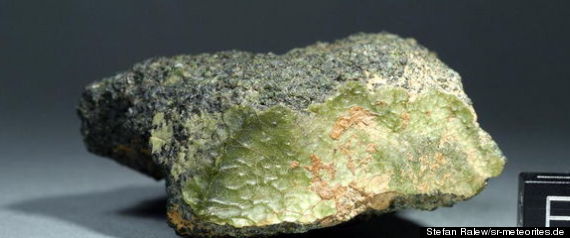
Green Meteorite's Age Casts Doubt on Possible Mercury Origin


A strange green space rock hailed as perhaps the first meteorite ever discovered from Mercury may be too old to have come from the solar system's innermost planet, some scientists say.

Last month, scientists announced that the green-hued meteorite NWA 7325 shares many chemical similarities with Mercury, suggesting it may be the first known visitor from the small, sun-scorched planet.

But NWA 7325's advanced age — it's thought to be more than 4.5 billion years old — casts some doubt on this interpretation, some scientists have stressed, citing the example of Earth's moon to help make their point.

"The moon began to crystallize 4.5 billion years ago, but we don't have any 4.5-billion-year-old meteorites from the moon, because all of those rocks would have been bashed to smithereens during the Late Heavy Bombardment that pockmarked the moon with craters between 4 to 3.8 billion years ago," meteorite expert Randy Korotev, of Washington University in St. Louis, said in a statement.

“The same thing would have happened on Mercury, so the question is, How did this rock survive for that long?" Korotev added. "There's no sign of it being brecciated, or busted up."

Still, Korotev doesn't rule out the possibility that NWA 7325, which was found in Morocco last year, is indeed from Mercury. Further tests could help researchers get a better sense of the meteorite's origins, he added.

A test with the potential to be particularly informative would assess NWA 7325's levels of "cosmogenic radionuclides," unstable atoms generated by exposure to cosmic radiation.

"If this stone had exceedingly high cosmogenic nuclides, that would be an argument for it coming from Mercury, because Mercury is so close to the sun," Korotev said.

While NWA 7325's exact provenance remains unclear at the moment, scientists do know something about its origins. The meteorite is an achondrite, a relatively rare type of space rock that comes from a planet or big asteroid — something large that generated enough internal heat early in its history to melt partially, producing a metallic core surrounded by rock.

And researchers have a pretty good idea of where its green color comes from.

"I once analyzed bottles to see what made them blue or green," Korotev said. "The greenest bottle had 660 parts per million chromium, but some of the mineral components of NWA 7325 have 7,000 parts per million chromium. That's why it's green."

Sunday, April 7, 2013


 Higgs keeps mum about universe's secrets – for now


The Higgs boson will not open the door to exotic new physics anytime soon. The last remaining quirk in the particle's known properties has vanished from the data of one of the two experiments responsible for detecting the boson.

The Large Hadron Collider at CERN near Geneva, Switzerland, doesn't see the Higgs directly, but instead looks for the slew of particles it decays into. Back in July, when the ATLAS and CMS experiments, both at the LHC, announced the particle's discovery, they reported a number of anomalies, including almost twice as many pairs of photons among the decay debris as is predicted by the standard model of particle physics.

Since the standard model still can't explain everything, including dark matter and gravity, many hoped these anomalies would provide a clue as to how to extend the model.

Rumour confirmed

But, as more LHC data has accumulated, the quirks have vanished, leaving only the photon excess. Now even this looks unlikely to stick around. Last week, ATLAS published its most recent analysis, which failed to shed light on whether the excess was real or not.

CMS, meanwhile, has remained silent on the matter since July – though a rumour that surfaced on Twitter last week suggested that the experiment's excess of photons, also referred to as gamma rays, might have decreased, bringing it closer to the predictions of the standard model.

CMS has now confirmed that this is the case. "The new signal strength measurement from CMS in the two-gamma channel has a central value near to 1 – closer to the standard model value," Joe Incandela, spokesperson for CMS, told New Scientist.

Christophe Ochando of CMS presented the results at the Moriond meeting in La Thuile, Italy,last month

Although the CMS results don't point to any deviation from the standard model, as some had hoped they might, Incandela emphasises that this doesn't mean that the Higgs found at the LHC is the one predicted by the standard model

Options open    


Though an excess of photons would provide constraints on how to extend the standard model, the lack of an excess simply leaves the options for extensions wider open, says Albert De Roeck, also of CMS.

A rate of photon decay close to the standard model "is still new physics and there are a great deal of models that can come with such a number", De Roeck says.

Physicist and blogger Matt Strassler points out on his blog that ATLAS still hasn't ruled out the photon excess, leaving the possibility that the Higgs really does decay into more photons than predicted by the standard model.

But he adds that we won't know if this is the case for a while, since the results presented at Moriond represent the full data set collected so far, and the LHC has now shut for two years.

"Sorry, but if there's anything about this Higgs particle that is dramatically different from a Standard Model Higgs (the simplest possible type of Higgs particle), we'll have to look elsewhere in the 2011-2012 data to find it. Or we'll have to wait till 2015," Strassler writes.